US Wildflower Planting Forecast
2026–27 Planting Forecast
When to sow each of our regional mixes this season, built from ten years of weather data, NOAA’s El Niño outlook, published sowing guidance and what we’ve seen grow. It’s a general guide by design, and we spell out where it generalizes and why.
When to sow, every region
Best sowing windows for the 2026–27 season
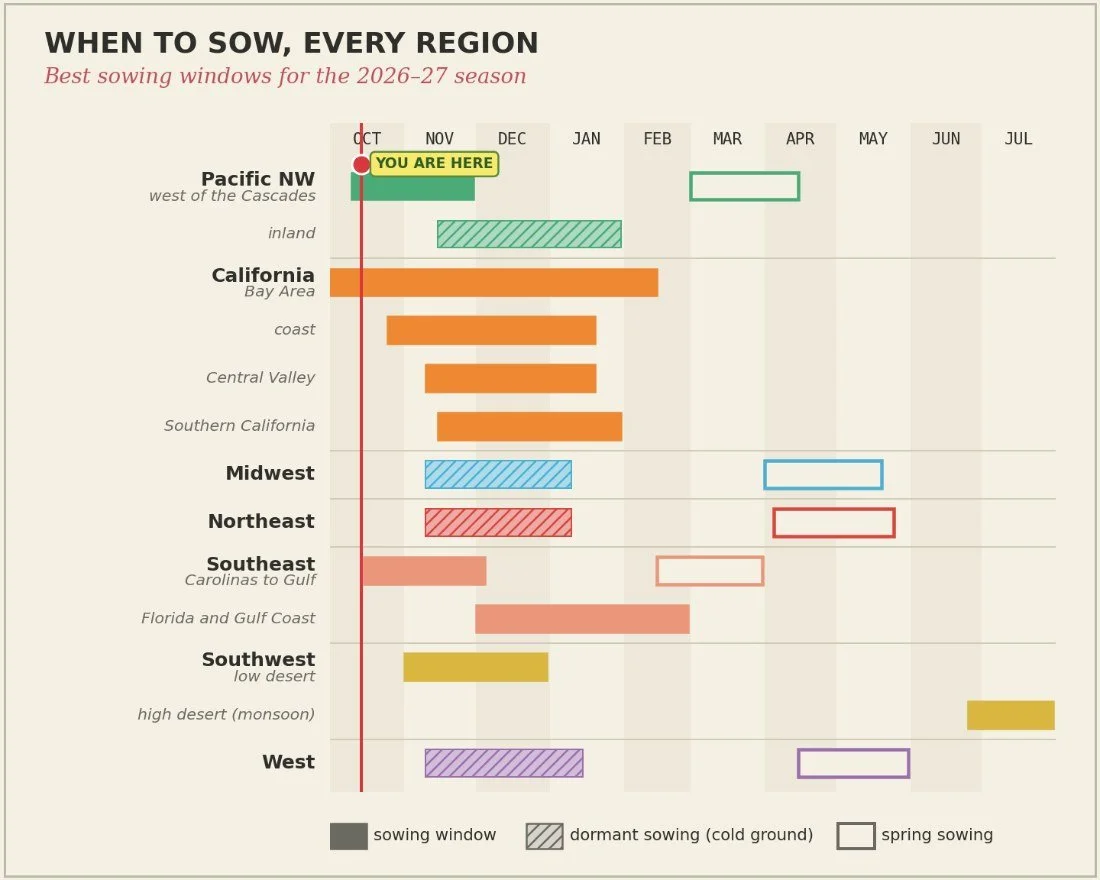
Solid bars are the main sowing windows. Striped bars are dormant sowing, onto cold ground after the first hard freezes. Outlined bars are the spring second chance. Find your region below for the details.
How this forecast works
What we generalize, why, and where it breaks down
This is a general guide to sowing native wildflowers across whole regions, so it has to generalize. Native species vary in what they need, and conditions change from one garden to the next. Rather than hide that, here are the working rules behind every window on this page, where they come from, and where they stop holding. The regions themselves follow the regions we use for our native seed mixes.
Our forecast flags a sowing window when three signals line up. These are the settings in our own forecast tool. We chose them from published sowing guidance and our own sowing experience; they are rules of thumb for native wildflowers in general, not lab data for any one species.
| Signal | Our working rule | Why we use it | Where it doesn’t hold |
|---|---|---|---|
| Soil temperature | About 45–72°F | Most cool-season native annuals and many native perennials germinate in this range. | Warm-season and desert species want warmer soil. Seed that needs a winter of cold won’t sprout in this range until after that cold. Our figures are for the soil layer 3–11 inches down; the surface, where seed actually sits, swings warmer and colder from day to day. |
| Rain after sowing | About 1¼ inches in the 3 weeks after sowing | Our rule of thumb for keeping the surface moist through germination without a hose. | One big storm isn’t the same as steady showers, and sandy soil dries faster than clay. If two dry weeks follow sowing, water. |
| Hard freeze | Watch for nights at or below 28°F | Seedlings that sprout in fall need a few weeks to root before a hard freeze. | Not a concern for dormant sowing, where seed waits in cold soil on purpose. Many annuals spend winter as low rosettes and handle light frost well. |
Fall, dormant and spring sowing
- Fall sowing (Pacific Northwest west of the Cascades, California, Southeast, low desert): seed sprouts with fall and winter rain and blooms in spring. UC Davis Arboretum recommends October to November for California natives, and the Xerces Society lists October to January for California annual wildflowers.
- Dormant sowing (Midwest, Northeast, West, inland Northwest): seed goes onto cold soil after the first hard freezes and waits for spring. Prairie Moon Nursery notes that overwintering stratifies seed naturally, so fall-sown seed doesn’t need pre-treatment. Freeze and thaw also work it into the soil.
- Spring sowing (cold regions and the Northwest): a second chance once soil passes about 50°F and spring rain arrives. The Xerces Society notes it tends to favor grasses over wildflowers, so we treat it as the backup.
Quickstart
- Clear the spot of weeds and grass; rake the soil loose on top.
- Mix seed with sand or soil so it spreads evenly.
- Scatter by hand, then press it in by walking on it or rolling it. UC Davis Arboretum’s advice is plain: “Do not bury the seeds or they will not sprout.”
- Let the rain water it. Water if two dry weeks follow sowing.
Want the method behind the numbers? See Behind the numbers at the end of this page.
Pacific Northwest
Washington, Oregon and northern Idaho: fall rains are back
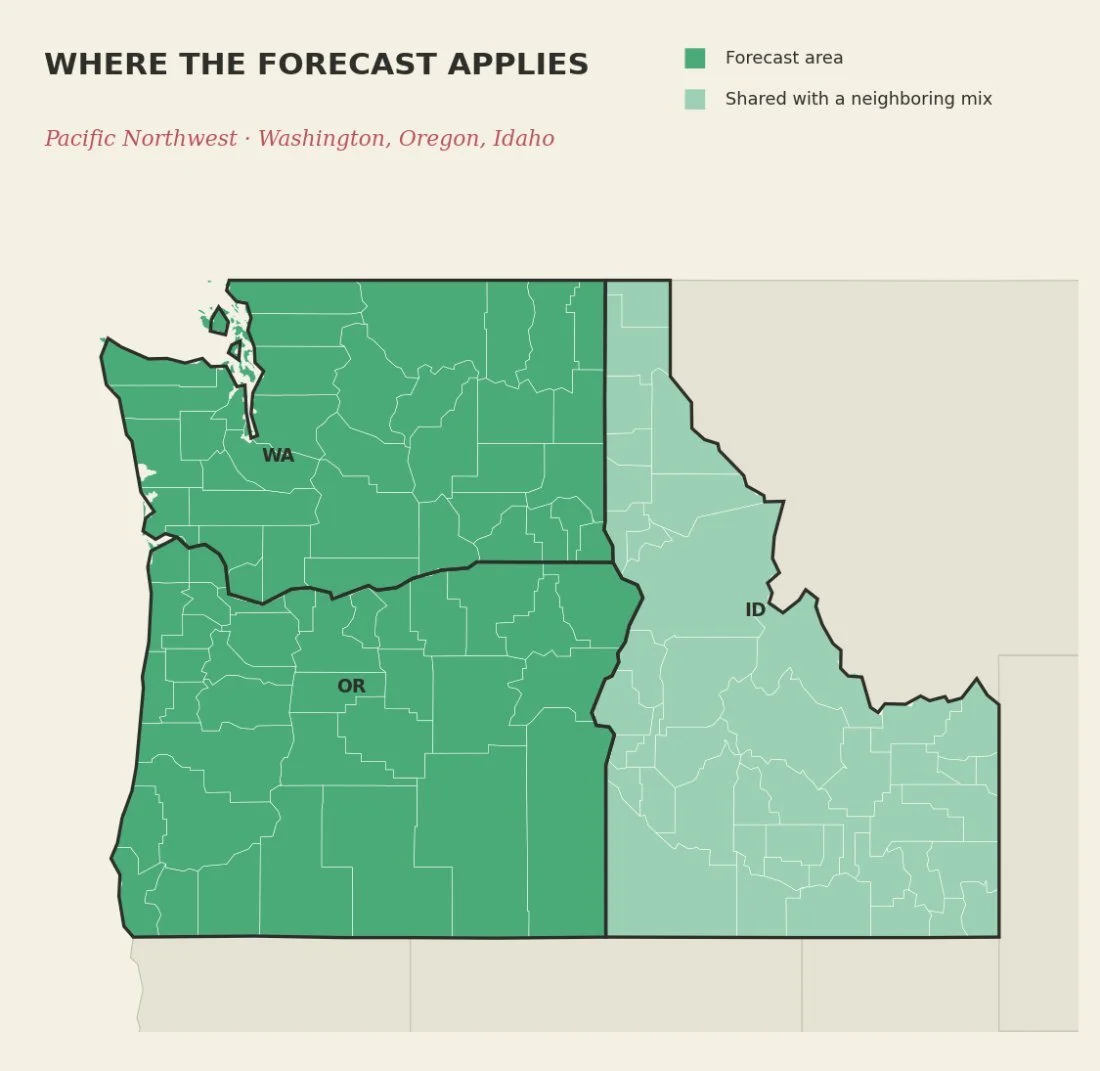
- Best sowing
- Mid-October through November west of the Cascades · dormant sowing mid-November into January inland · March to mid-April in spring
- Covers
- Washington, Oregon, northern Idaho
- Sample cities
- Portland, Seattle (west) · Spokane (inland)
Shop the Pacific Northwest Mix →
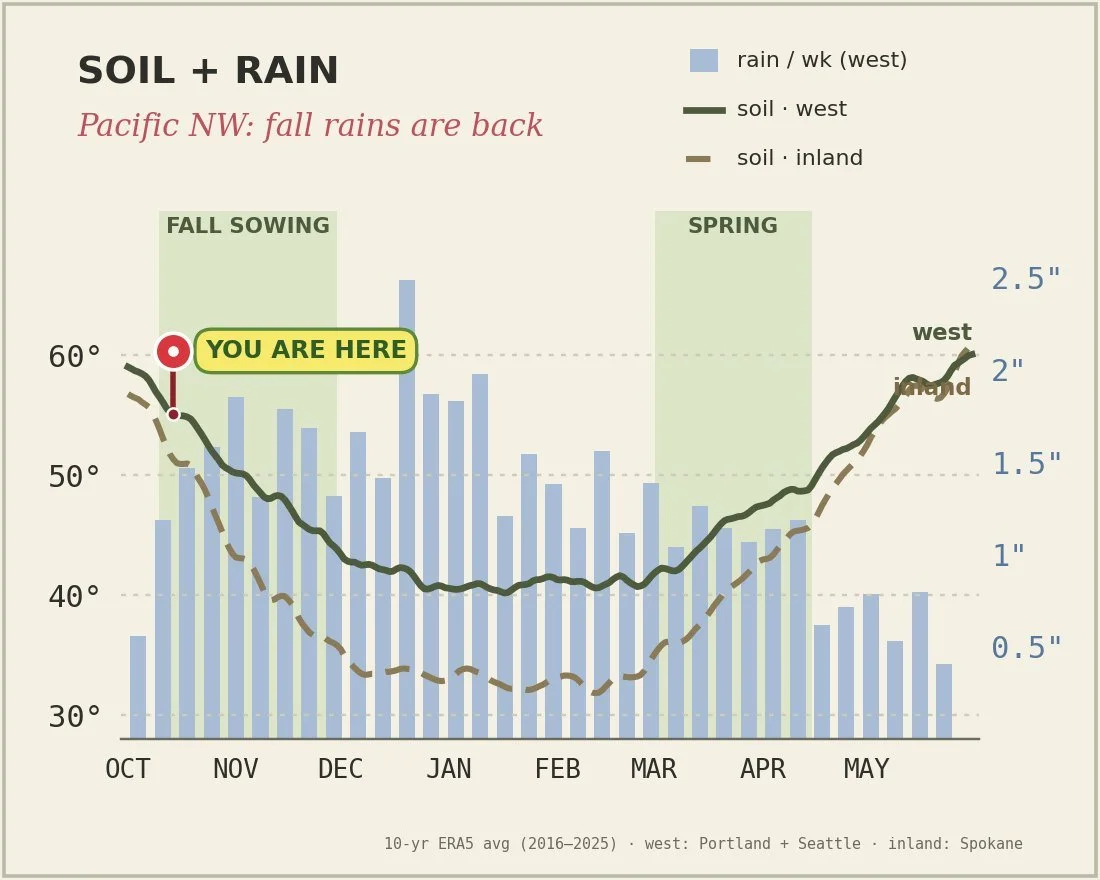
Soil around Portland and Seattle is in the mid-50s and falling about 7°F a month, while weekly rain has already returned to 1–2 inches. Soil that’s still warm enough for fast germination plus rain that can carry seed without watering is what we look for, and the two overlap from now through November. Inland, Spokane is colder and drier, with soil near 40°F and 10 hard-freeze nights by November, so the east side shifts to dormant sowing. In spring, west-side soil passes 45°F in March with 4–6 inches of rain a month, a dependable second window before the dry summer.
Month by month · west (Portland) and inland (Spokane)
| Month | Portland soil | Portland rain | Portland ≤28°F | Spokane soil | Spokane rain | Spokane ≤28°F |
|---|---|---|---|---|---|---|
| Oct | 56°F | 5.7" | — | 52°F | 2.1" | 2.2 |
| Nov | 48°F | 7.7" | 0.6 | 40°F | 2.8" | 10.2 |
| Dec | 43°F | 8.4" | 1.9 | 35°F | 2.8" | 18.9 |
| Jan | 41°F | 7.6" | 3.7 | 34°F | 2.3" | 17.5 |
| Feb | 42°F | 6.0" | 4.4 | 34°F | 2.0" | 16.9 |
| Mar | 45°F | 5.8" | 0.7 | 40°F | 2.1" | 9.8 |
| Apr | 51°F | 4.4" | 0.1 | 48°F | 1.6" | 1.4 |
| May | 58°F | 3.0" | — | 58°F | 1.8" | — |
How we’d sow it
- West of the Cascades: sow now through November for the strongest fall start.
- Eastern Washington and Oregon, northern Idaho: sow onto cold ground from mid-November, before snow.
- Missed fall? March to mid-April is a strong second window on the west side.
- Where this varies: higher elevations and rain-shadow areas run colder and drier, so treat them like the inland calendar.
California
Valley, coast, Bay Area and Southern California
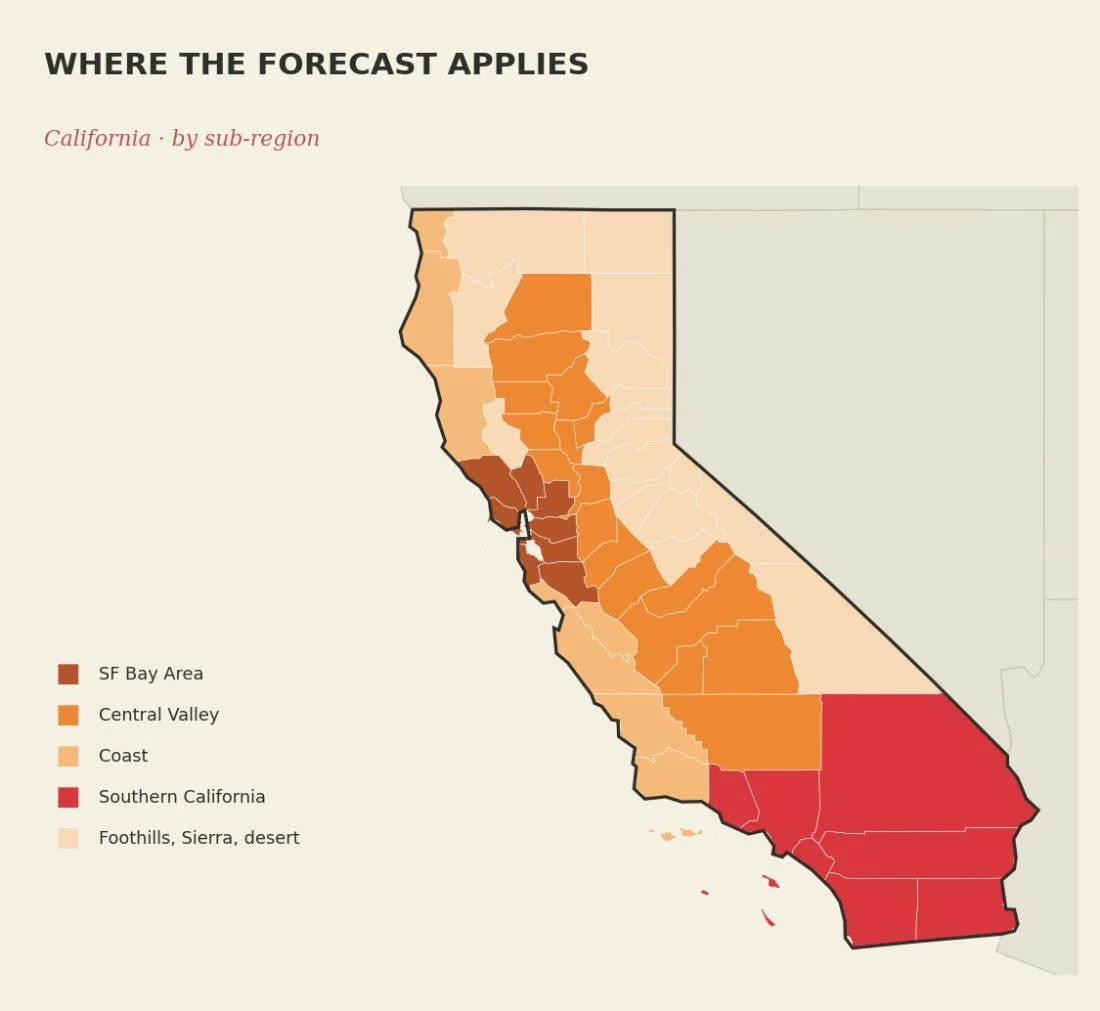
- Best sowing
- November 1 to late January statewide · October through mid-February in the Bay Area · mid-November through January in Southern California
- Covers
- California
- Sample cities
- Sacramento, Modesto (valley) · Salinas, Arcata (coast) · San Francisco · Los Angeles, San Diego
Valley and coast
Sow into the first real rains
Central Valley Mix → Coastal Mix →
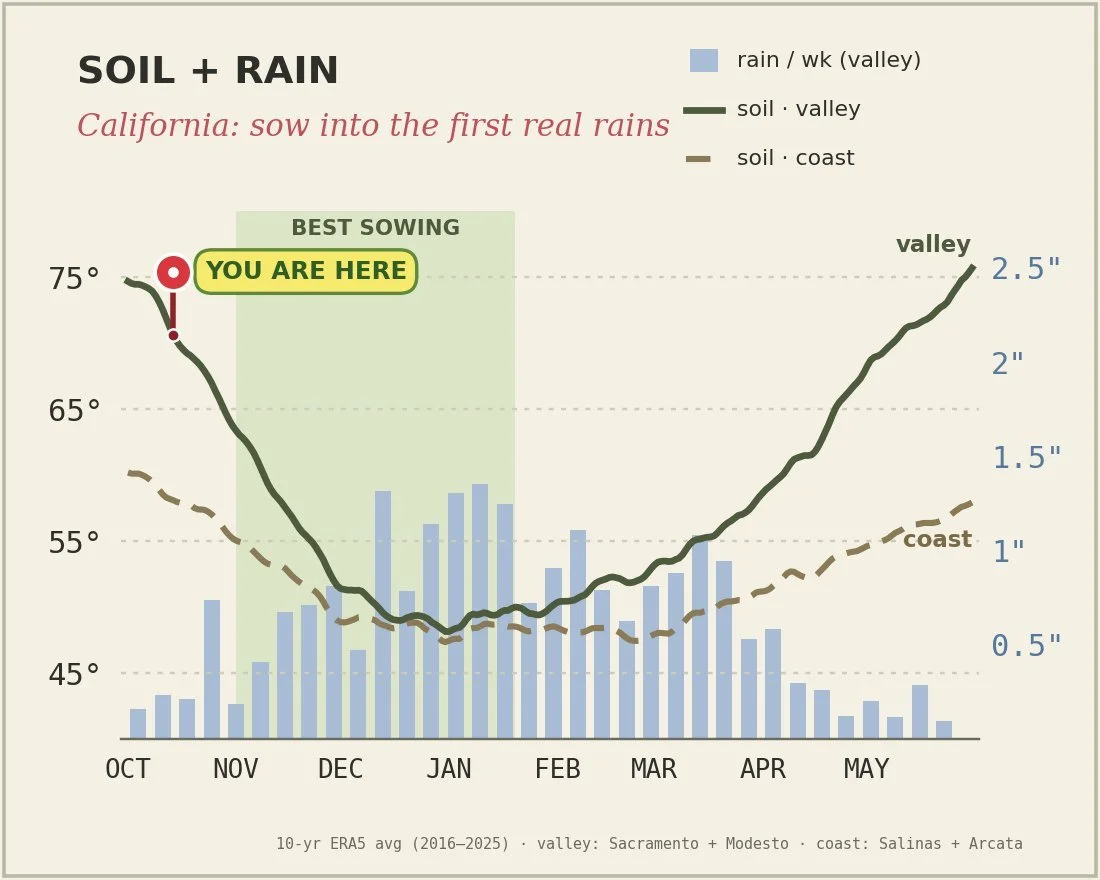
Central Valley soil is still near 70°F in mid-October, above the ideal range, and the rains have not started. By November soil falls into the high 50s and the first storms arrive; December and January bring 4–5 inches each. The coast is cooler and wetter earlier, so coastal gardens can start a week or two sooner. Hard freezes are rare in both.
Month by month · Valley (Sacramento) and Coast (Salinas)
| Month | Valley soil | Valley rain | Valley ≤28°F | Coast soil | Coast rain | Coast ≤28°F |
|---|---|---|---|---|---|---|
| Oct | 70°F | 1.7" | — | 63°F | 0.8" | — |
| Nov | 57°F | 2.7" | — | 56°F | 2.1" | — |
| Dec | 49°F | 5.1" | 0.3 | 52°F | 4.0" | — |
| Jan | 49°F | 5.1" | 0.1 | 51°F | 4.6" | — |
| Feb | 51°F | 4.4" | 0.2 | 52°F | 3.2" | — |
| Mar | 55°F | 4.2" | — | 54°F | 4.0" | — |
| Apr | 62°F | 1.5" | — | 57°F | 1.3" | — |
| May | 72°F | 0.8" | — | 60°F | 0.6" | — |
Our advice
- Prep beds now; sow with the first soaking storm of November.
- Coast: begin late October if a storm is in the forecast.
- Valley: aim for mid-November to mid-December.
- Sowing through January still works, with a shorter run before spring heat.
- Where this varies: the foothills, the Sierra and the desert edge follow their own calendars. This section covers the valley, the coast, the Bay Area and Southern California’s coastal plain.
El Niño SF Bay Forecast
What a strong El Niño winter means for sowing
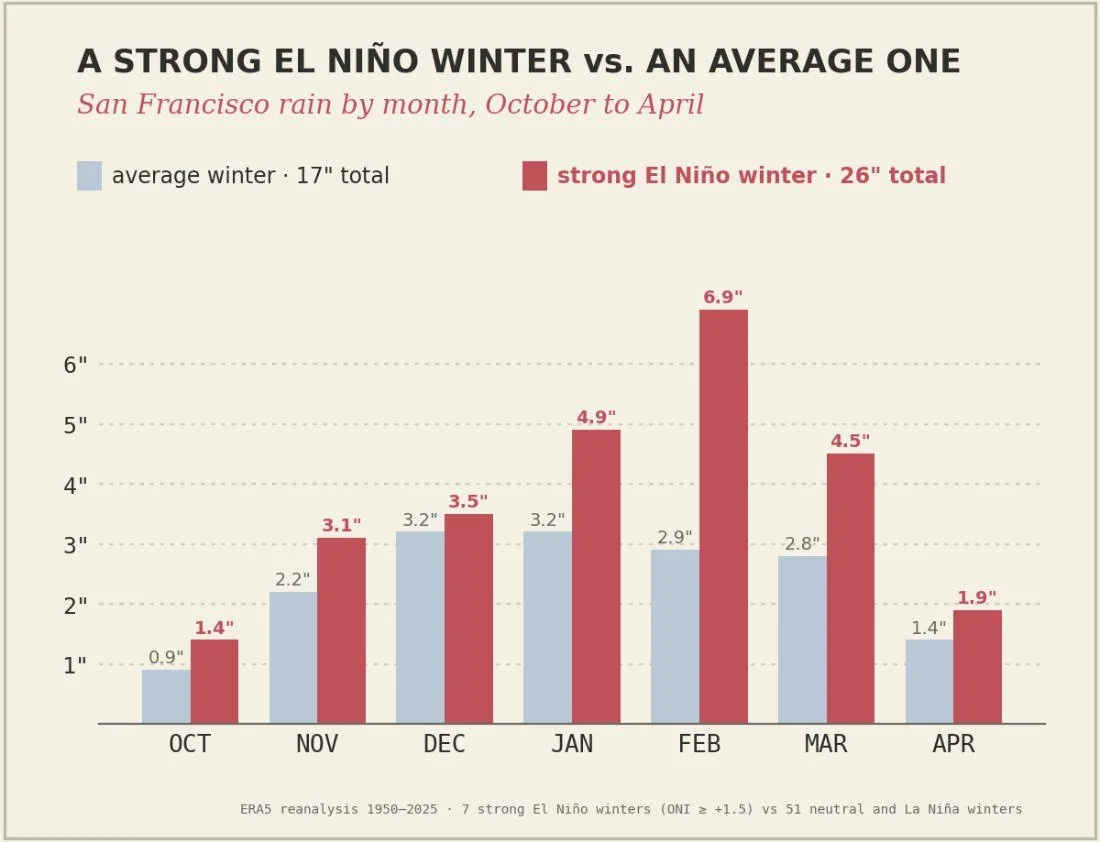
NOAA’s Climate Prediction Center has an El Niño Advisory in effect. In its October 8, 2026 update, sea surface temperatures in the key Niño-3.4 region were about 2.1°C above normal, and NOAA put the chance of a strong-to-very-strong El Niño lasting through January–March 2027 above 83%. To see what that has meant for Bay Area gardens in the past, we went back through every San Francisco winter (October through April) from 1950 to 2025 and grouped them by El Niño strength.
What the record shows · San Francisco, October–April, 1950–2025
| Winter type | Winters | Avg rain | Rainy days | 1"+ storm days | Dec–Feb | Mar–Apr |
|---|---|---|---|---|---|---|
| Strong El Niño | 7 | 26.1" | 53 | 4.3 | 15.2" | 6.4" |
| All El Niño | 25 | 19.9" | 42 | 3.2 | 12.2" | 4.5" |
| Neutral | 25 | 16.6" | 34 | 2.6 | 9.8" | 4.0" |
| La Niña | 26 | 16.6" | 37 | 2.1 | 8.8" | 4.4" |
| All other winters | 51 | 16.6" | 35 | 2.3 | 9.3" | 4.2" |
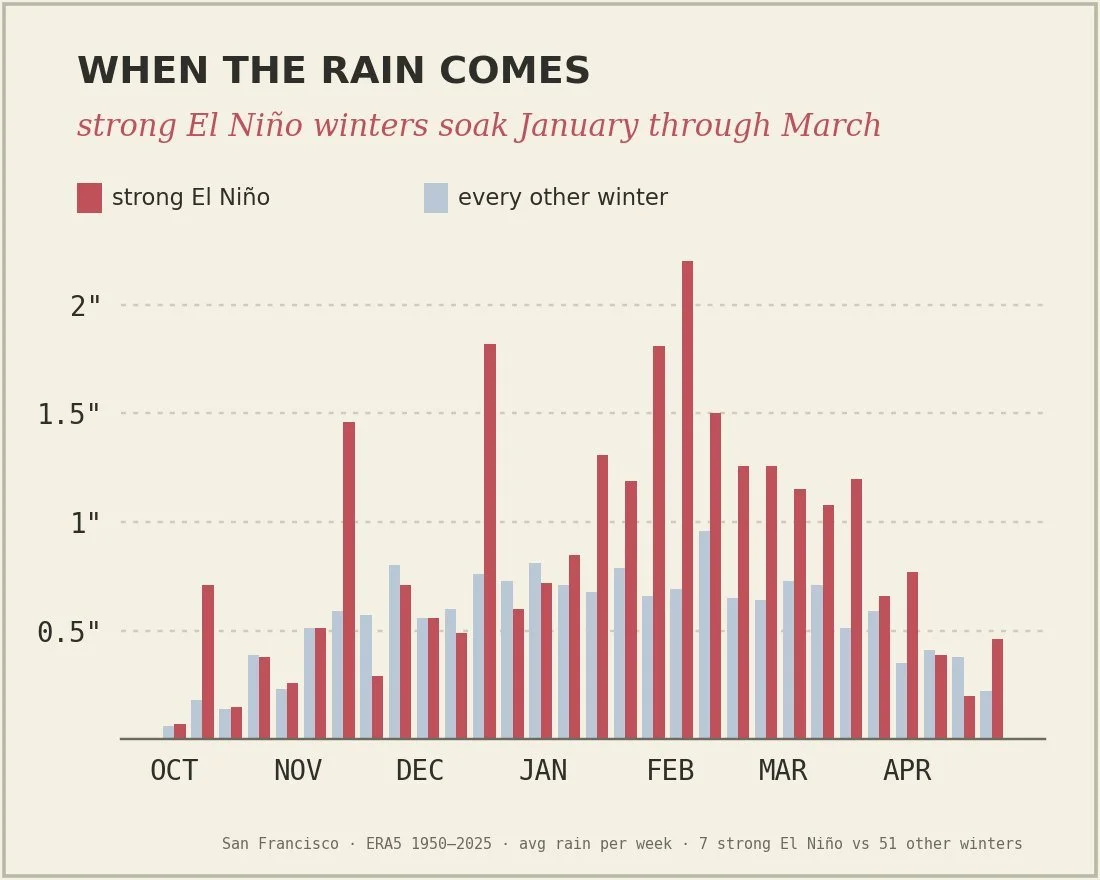
In those 76 winters, the seven strong El Niño years averaged about 26 inches of rain, compared with about 17 in the 51 neutral and La Niña winters. They also had nearly twice as many days with an inch of rain or more, and most of the extra water fell from January through April. The season’s first full inch of rain (counting from October 1) arrived around October 27 on average in strong El Niño years, versus around November 8 in the others.
Seven winters is a small sample, and it isn’t a promise. Strong El Niños in 1991 and 2015 brought close-to-normal rain. Across all 25 El Niño winters, 64% beat the long-term median, compared with 43% of other winters. So we read this as better odds of a wet winter, not a guarantee.
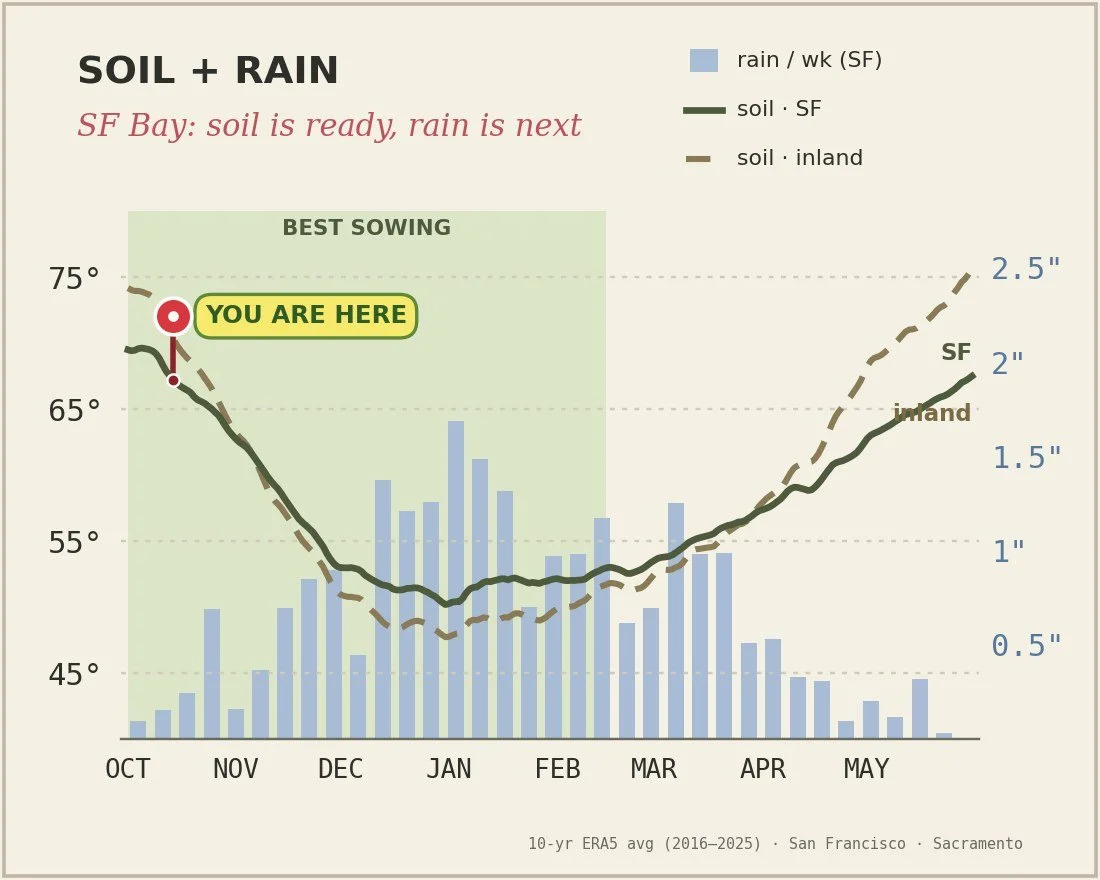
Month by month · San Francisco and Sacramento (typical year)
| Month | SF soil | SF rain | SF ≤28°F | Sacramento soil | Sacramento rain | Sacramento ≤28°F |
|---|---|---|---|---|---|---|
| Oct | 67°F | 1.2" | — | 70°F | 1.7" | — |
| Nov | 58°F | 2.5" | — | 57°F | 2.7" | — |
| Dec | 52°F | 5.2" | — | 49°F | 5.1" | 0.3 |
| Jan | 52°F | 5.0" | — | 49°F | 5.1" | 0.1 |
| Feb | 53°F | 3.8" | — | 51°F | 4.4" | 0.2 |
| Mar | 55°F | 4.0" | — | 55°F | 4.2" | — |
| Apr | 60°F | 1.3" | — | 62°F | 1.5" | — |
| May | 65°F | 0.7" | — | 72°F | 0.8" | — |
Our take
If this winter follows the pattern, Bay Area seed should get steady moisture through germination and a longer, fuller spring. The risk we’d plan around is heavy storms washing seed off bare or sloped ground. The record doesn’t tell you which week the rain starts, so let the local forecast set your sowing day.
- Sow any time from October through mid-February. Earlier gives seed more time to settle before the biggest storms.
- Aim to sow just ahead of a forecast soaking rain, and press the seed in firmly.
- On slopes or bare runoff paths, hold off when a 1-inch-plus storm is in the forecast.
Southern California
Spotlight on Los Angeles and San Diego
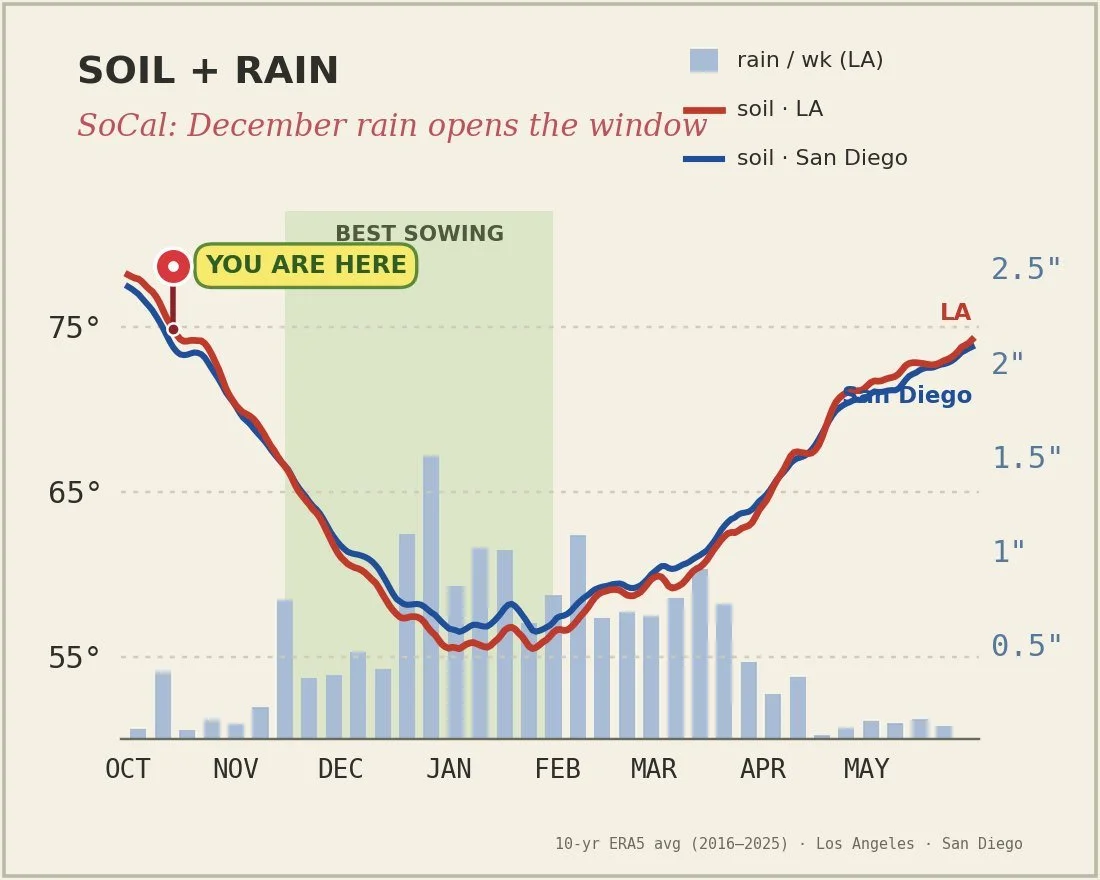
Southern California soil stays above the ideal range into November, and October and November together bring only about 2 inches of rain. The window opens when soil drops into the low 60s and December rains arrive, then stays open through January. Neither city sees hard freezes. Los Angeles averages more winter rain than San Diego (about 3.7" vs 2.2" in December); San Diego runs a degree or two warmer.
Month by month · Los Angeles and San Diego
| Month | LA soil | LA rain | LA ≤28°F | SD soil | SD rain | SD ≤28°F |
|---|---|---|---|---|---|---|
| Oct | 75°F | 0.6" | — | 74°F | 0.5" | — |
| Nov | 66°F | 1.6" | — | 66°F | 1.4" | — |
| Dec | 58°F | 3.7" | — | 59°F | 2.2" | — |
| Jan | 56°F | 3.6" | — | 57°F | 2.9" | — |
| Feb | 58°F | 3.2" | — | 59°F | 2.2" | — |
| Mar | 61°F | 3.1" | — | 62°F | 2.5" | — |
| Apr | 68°F | 0.7" | — | 68°F | 0.8" | — |
| May | 73°F | 0.4" | — | 72°F | 0.5" | — |
How we’d sow it
- Hold off until mid-November; earlier seed sits in dry, warm soil.
- Sow ahead of the first December storm.
- In a strong El Niño, expect more help from rain January through March; keep sowing through January.
Midwest
Prairie country: sow dormant, then again in spring
- Best sowing
- Dormant sowing mid-November into early January · spring sowing April to mid-May
- Covers
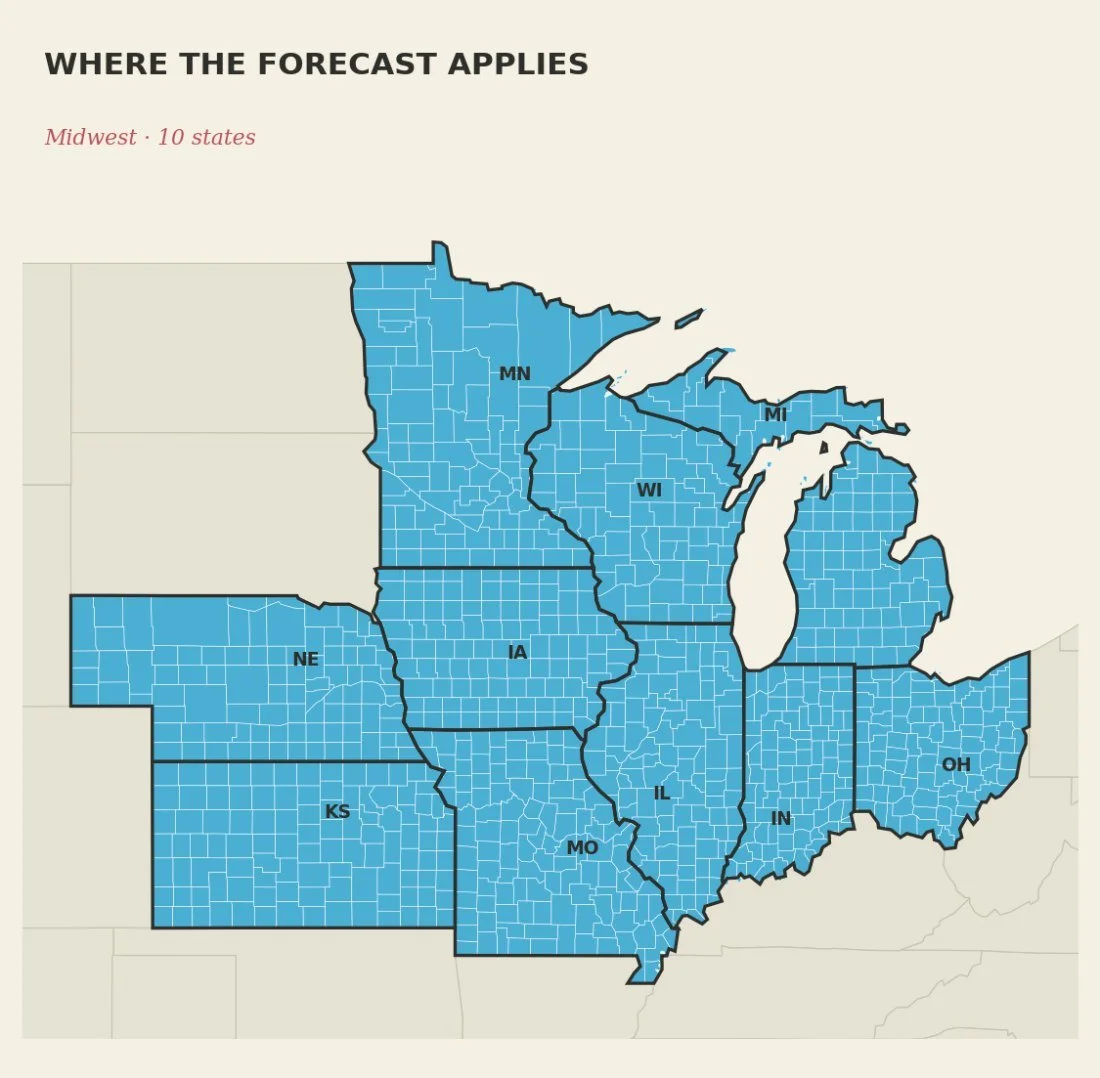
- Illinois, Indiana, Iowa, Kansas, Michigan, Minnesota, Missouri, Nebraska, Ohio, Wisconsin
- Sample cities
- Des Moines, Columbus
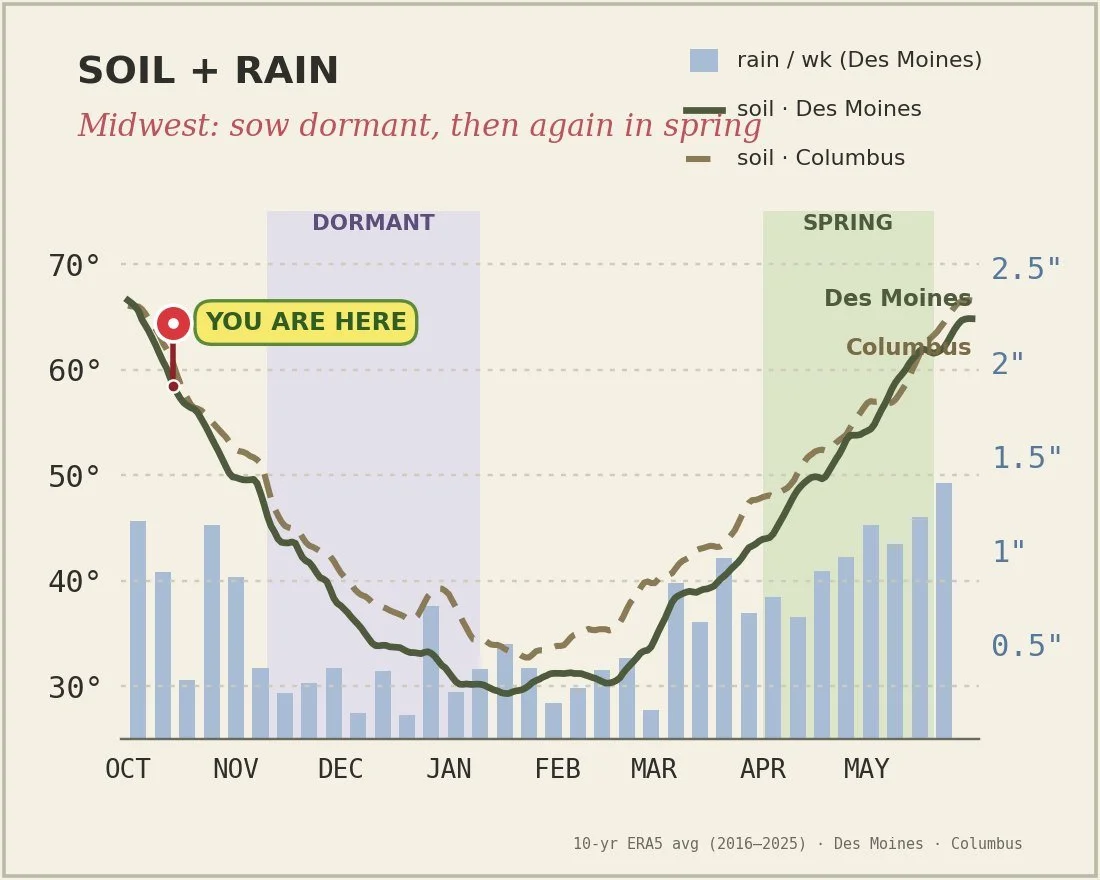
Midwest soil drops from the high 50s in October to the mid-40s in November, and hard freezes arrive with it: 6–9 nights in November, then 16–26 a month through February. That is the signal for dormant sowing. Seed scattered on cold ground stays put through winter, gets worked into the soil by freeze and thaw, and sprouts as the ground warms. The western Midwest (Des Moines) is drier in winter, under 2 inches a month, while Ohio stays at 3–4 inches. Spring sowing opens in April as soil passes 50°F and rain climbs to 4–5 inches by May.
Month by month · Des Moines and Columbus
| Month | Des Moines soil | Des Moines rain | Des Moines ≤28°F | Columbus soil | Columbus rain | Columbus ≤28°F |
|---|---|---|---|---|---|---|
| Oct | 58°F | 3.7" | 1.2 | 60°F | 3.4" | — |
| Nov | 44°F | 1.8" | 9.4 | 47°F | 3.1" | 6 |
| Dec | 34°F | 1.5" | 20.7 | 38°F | 3.3" | 15.9 |
| Jan | 30°F | 1.6" | 25.9 | 34°F | 3.4" | 21 |
| Feb | 31°F | 1.3" | 21.3 | 36°F | 4.0" | 16.8 |
| Mar | 40°F | 3.1" | 10.1 | 43°F | 4.5" | 10.1 |
| Apr | 49°F | 3.6" | 2.8 | 51°F | 4.6" | 2.2 |
| May | 61°F | 4.9" | — | 61°F | 4.9" | — |
Our advice
- Wait for the first hard freezes, then sow from mid-November until snow cover.
- Sowing onto a thin snow layer works too; the seed settles in as it melts.
- Spring: sow in April and into May once soil is workable.
- Where this varies: some prairie species sprout fine from a spring sowing with no winter at all. Dormant sowing simply covers both kinds of seed in a mix.
Northeast
New England to the Mid-Atlantic: dormant sowing after the first freezes
- Best sowing
- Dormant sowing mid-November into early January (Mid-Atlantic into December) · spring sowing early April to late May
- Covers
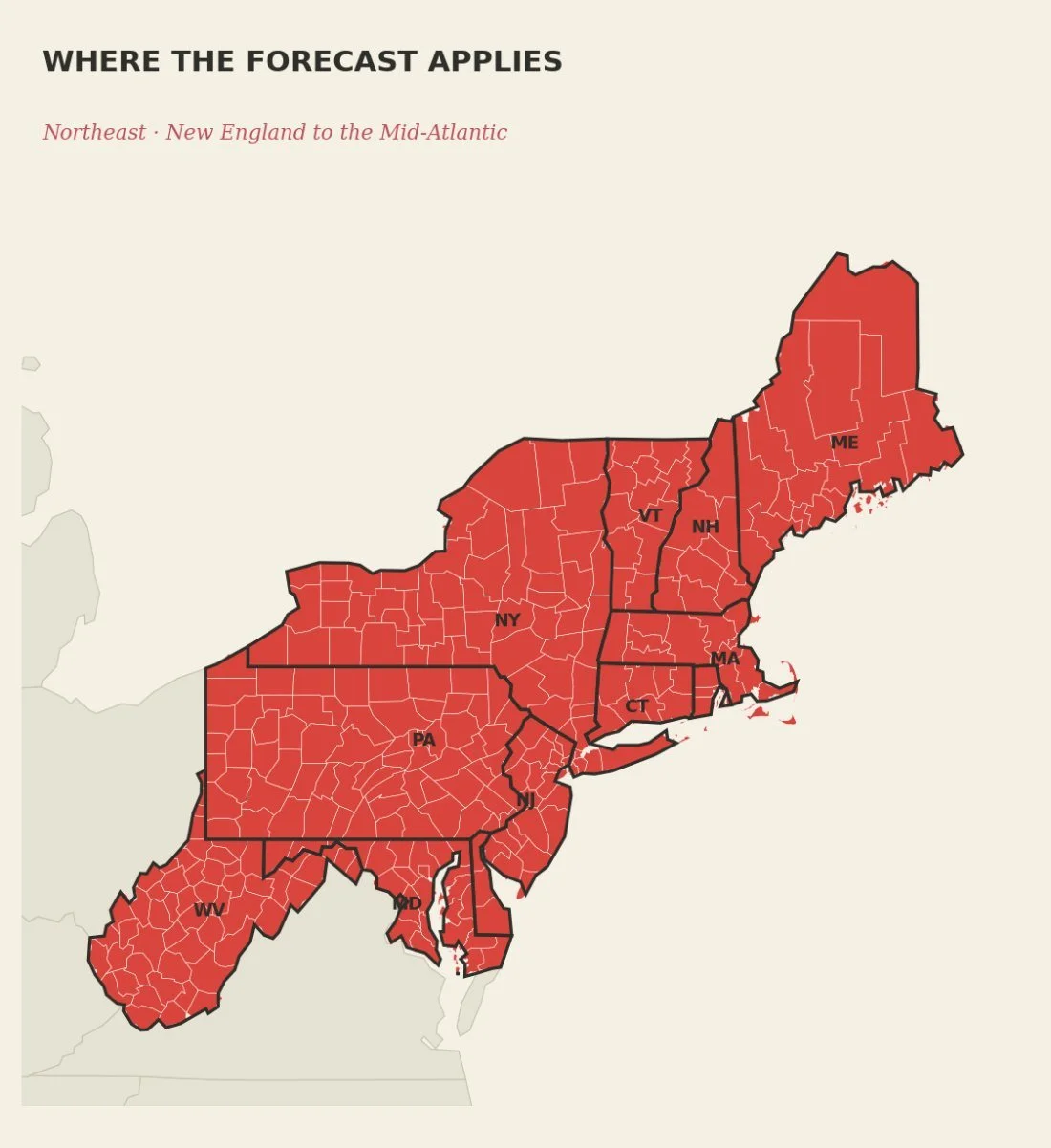
- Connecticut, Delaware, DC, Maine, Maryland, Massachusetts, New Hampshire, New Jersey, New York, Pennsylvania, Rhode Island, Vermont, West Virginia
- Sample cities
- Albany, Philadelphia
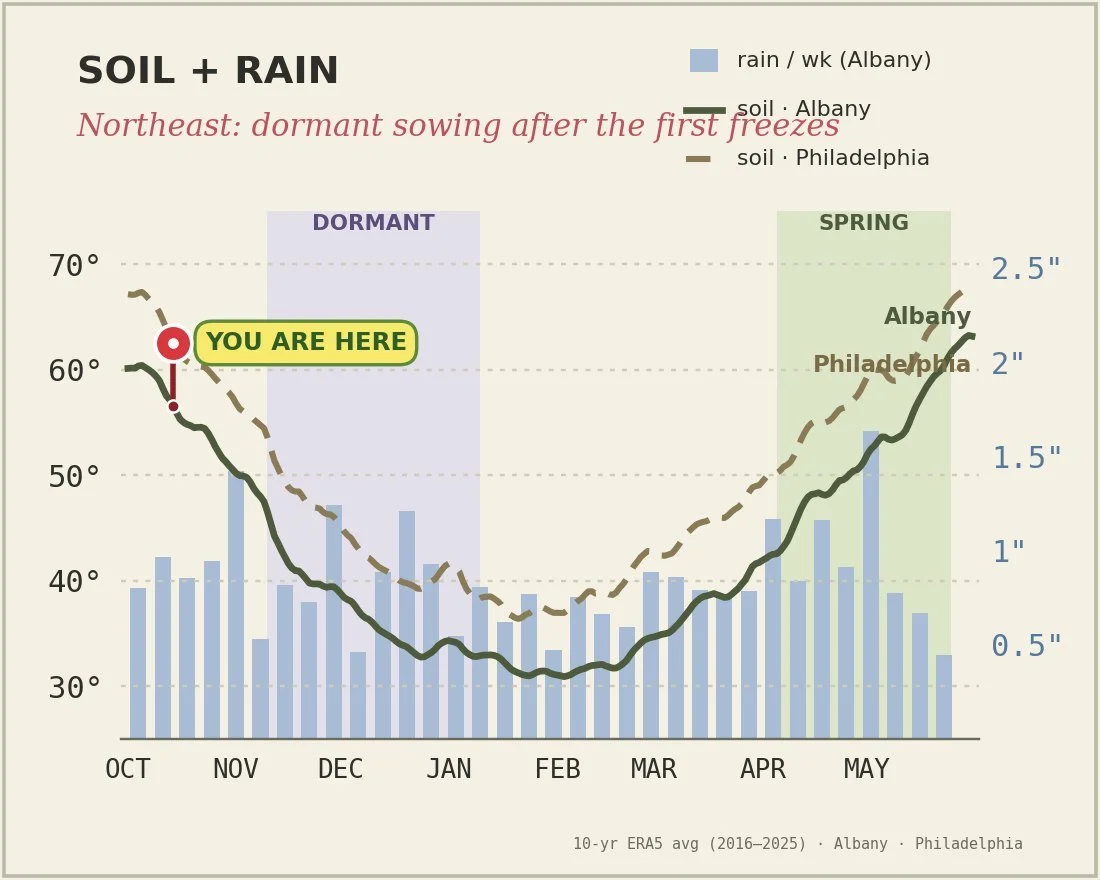
Upstate, soil falls from the mid-50s in October to the mid-40s in November, with about 7 hard-freeze nights in November and 20 or more a month through winter. The Mid-Atlantic runs about two weeks behind: Philadelphia soil is still near 51°F in November with only a couple of hard freezes, so dormant sowing there fits best from late November through December. Rain and snow are steady at 3–5 inches a month all season. Spring sowing opens in April as soil passes 50°F.
Month by month · Albany and Philadelphia
| Month | Albany soil | Albany rain | Albany ≤28°F | Philadelphia soil | Philadelphia rain | Philadelphia ≤28°F |
|---|---|---|---|---|---|---|
| Oct | 56°F | 4.6" | 0.1 | 63°F | 3.9" | — |
| Nov | 44°F | 3.4" | 7.1 | 51°F | 3.1" | 2.1 |
| Dec | 35°F | 3.9" | 19.9 | 41°F | 4.1" | 11.9 |
| Jan | 32°F | 2.9" | 24.2 | 38°F | 3.4" | 17.9 |
| Feb | 32°F | 2.8" | 21.6 | 39°F | 3.5" | 12.6 |
| Mar | 38°F | 3.5" | 15.2 | 45°F | 4.4" | 7.2 |
| Apr | 47°F | 4.7" | 2.2 | 54°F | 4.3" | 0.1 |
| May | 57°F | 3.7" | — | 63°F | 4.8" | — |
How we’d sow it
- New England and upstate New York: sow from mid-November onto cold soil.
- Mid-Atlantic: wait until late November, after the first hard freezes.
- Spring: sow in April once soil is workable; early May for northern New England.
- Where this varies: coastal areas and cities run warmer than Albany, and the mountains run colder.
Southeast
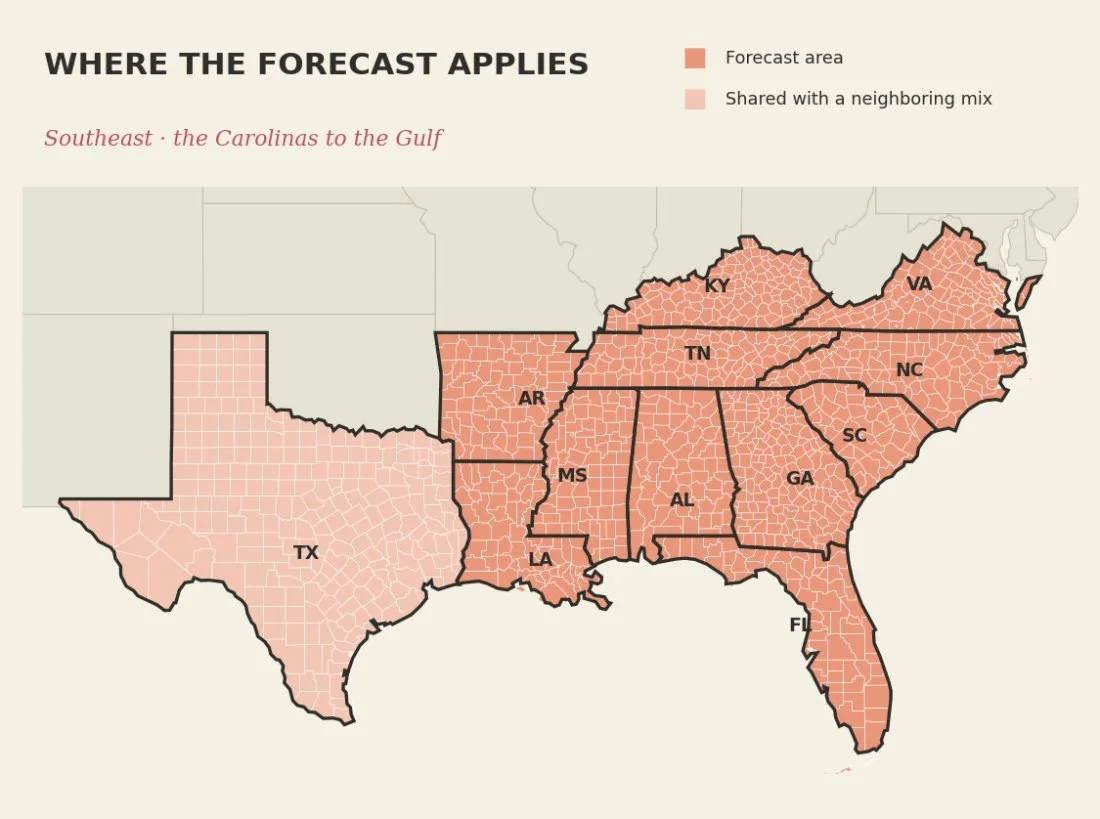
From the Carolinas to the Gulf: the window is open now
- Best sowing
- Mid-October to early December (fall) · December through February (Florida and Gulf Coast) · mid-February through March (spring)
- Covers
- Alabama, Arkansas, Florida, Georgia, Kentucky, Louisiana, Mississippi, North Carolina, South Carolina, Tennessee, Virginia, eastern Texas
- Sample cities
- Atlanta, Raleigh · Orlando · Austin
Shop the Southeast Mix → Florida Mix → Texas Mix →
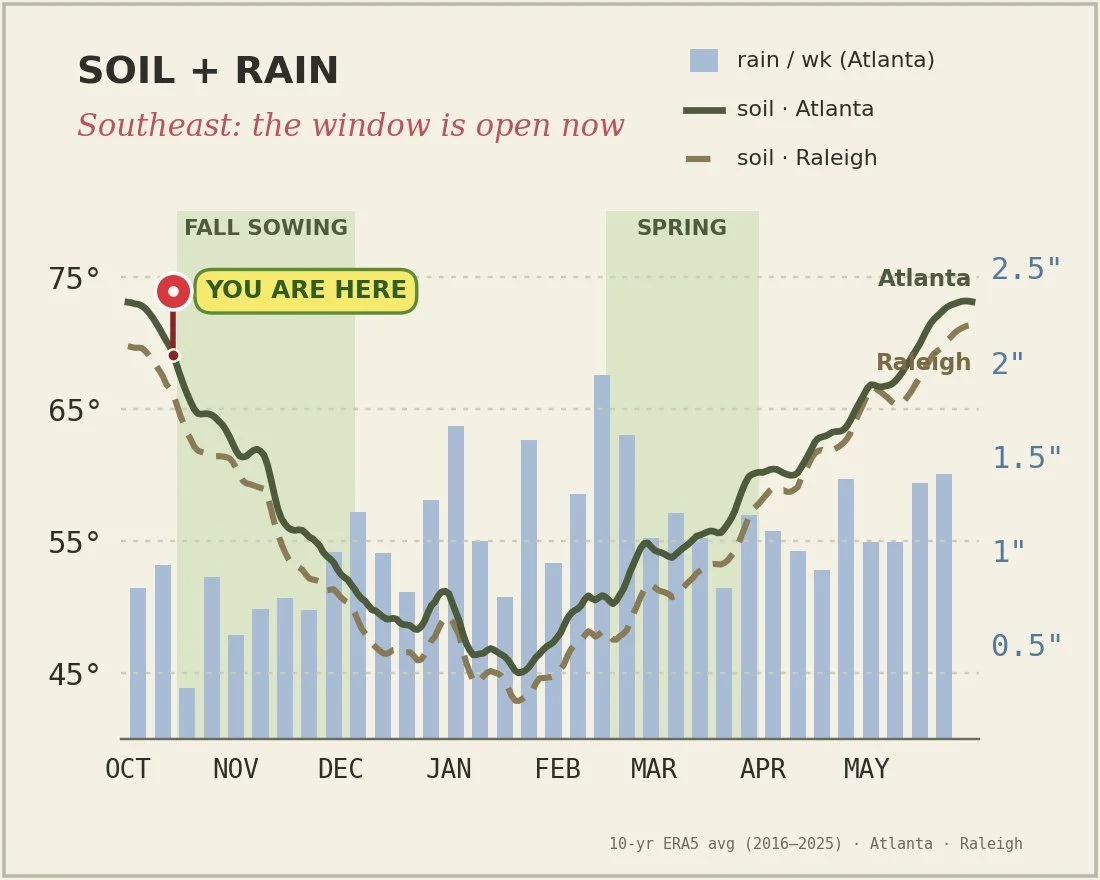
The Southeast is the one region where the window is wide open right now. Soil in Atlanta and Raleigh is in the mid-60s and drops into the 50s through November, with about 3 inches of rain a month and almost no hard freezes until mid-December. Seed that sprouts now has six to eight weeks to settle in as a low winter rosette, and seed that needs cold waits in the soil and comes up in spring. Florida and the Gulf Coast stay warm (soil in the 60s all winter) and are best sown December through February. A late-winter window reopens from mid-February as soil warms and rain runs 5–6 inches a month.
Month by month · Atlanta and Raleigh
| Month | Atlanta soil | Atlanta rain | Atlanta ≤28°F | Raleigh soil | Raleigh rain | Raleigh ≤28°F |
|---|---|---|---|---|---|---|
| Oct | 68°F | 3.2" | — | 65°F | 3.0" | — |
| Nov | 58°F | 2.9" | 0.7 | 55°F | 3.2" | 0.9 |
| Dec | 50°F | 4.7" | 3.2 | 48°F | 3.6" | 4.4 |
| Jan | 47°F | 5.3" | 8.4 | 45°F | 4.1" | 9.1 |
| Feb | 51°F | 5.8" | 2.1 | 48°F | 3.5" | 3.5 |
| Mar | 56°F | 5.0" | 1 | 53°F | 3.8" | 1.1 |
| Apr | 62°F | 4.6" | — | 61°F | 3.8" | — |
| May | 70°F | 5.4" | — | 68°F | 4.6" | — |
Florida and eastern Texas
| City | Nov | Dec | Jan | Feb | Hard freezes |
|---|---|---|---|---|---|
| Orlando | 71°F / 2.8" | 66°F / 2.7" | 62°F / 2.7" | 66°F / 2.2" | None |
| Austin | 65°F / 3.0" | 58°F / 3.2" | 54°F / 2.9" | 57°F / 3.2" | 2–3 nights in Jan |
Our advice
- Sow now through early December across the Piedmont and upper South.
- Florida and the Gulf Coast: sow December through February.
- Eastern Texas: November and December.
- Missed fall? Mid-February through March still works before the heat.
- Where this varies: the mountains of the Carolinas, Tennessee and Virginia behave more like the Northeast.
Southwest
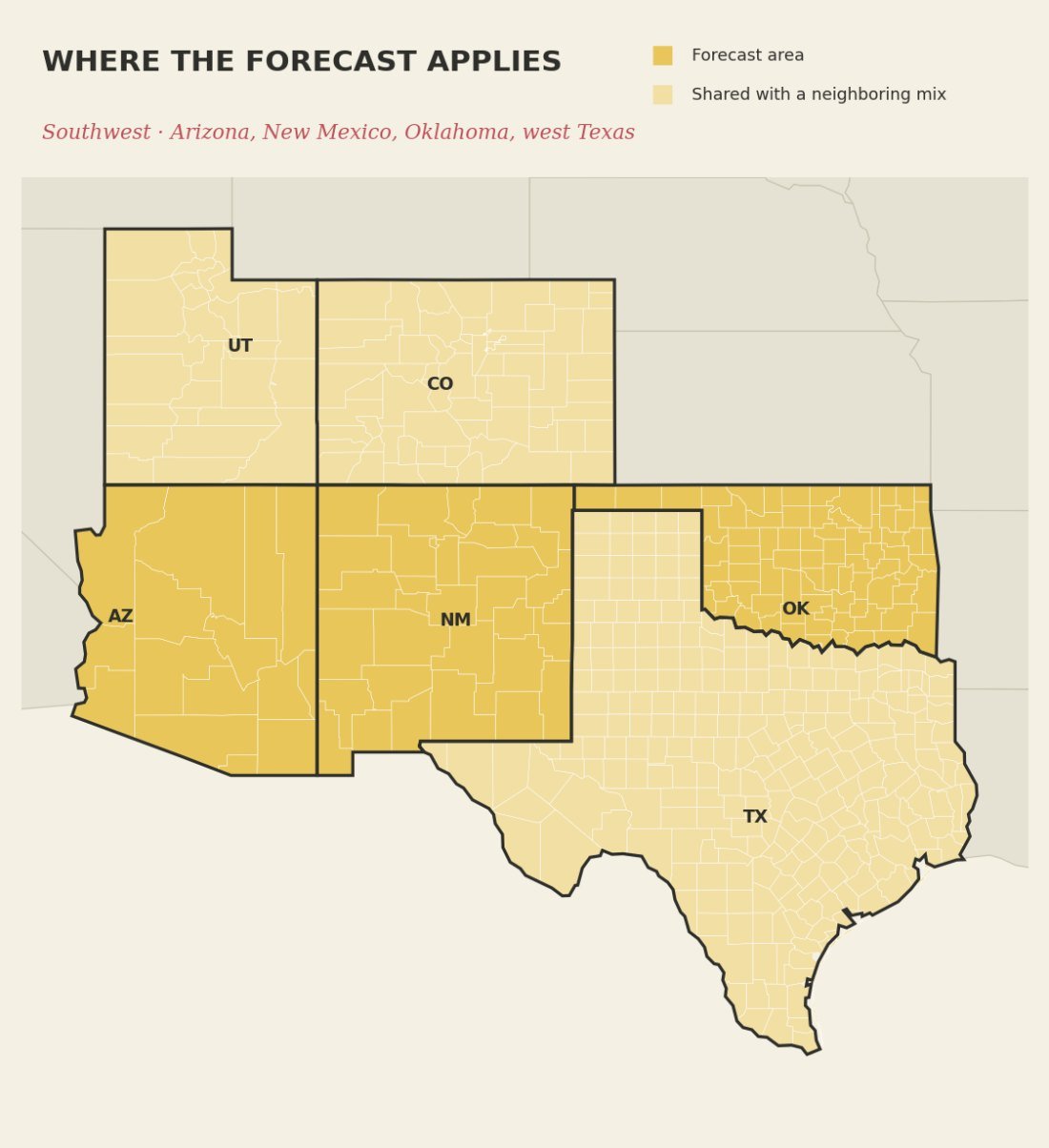
Arid country: sow ahead of the rains
- Best sowing
- November through December (low desert) · late fall onto cold ground for cool-season species, or late June ahead of the monsoon for summer-germinating species (high desert)
- Covers
- Arizona, New Mexico, Oklahoma, western Texas, southern Utah and Colorado
- Sample cities
- Phoenix, Albuquerque
Shop the Southwest Mix → Texas Mix →
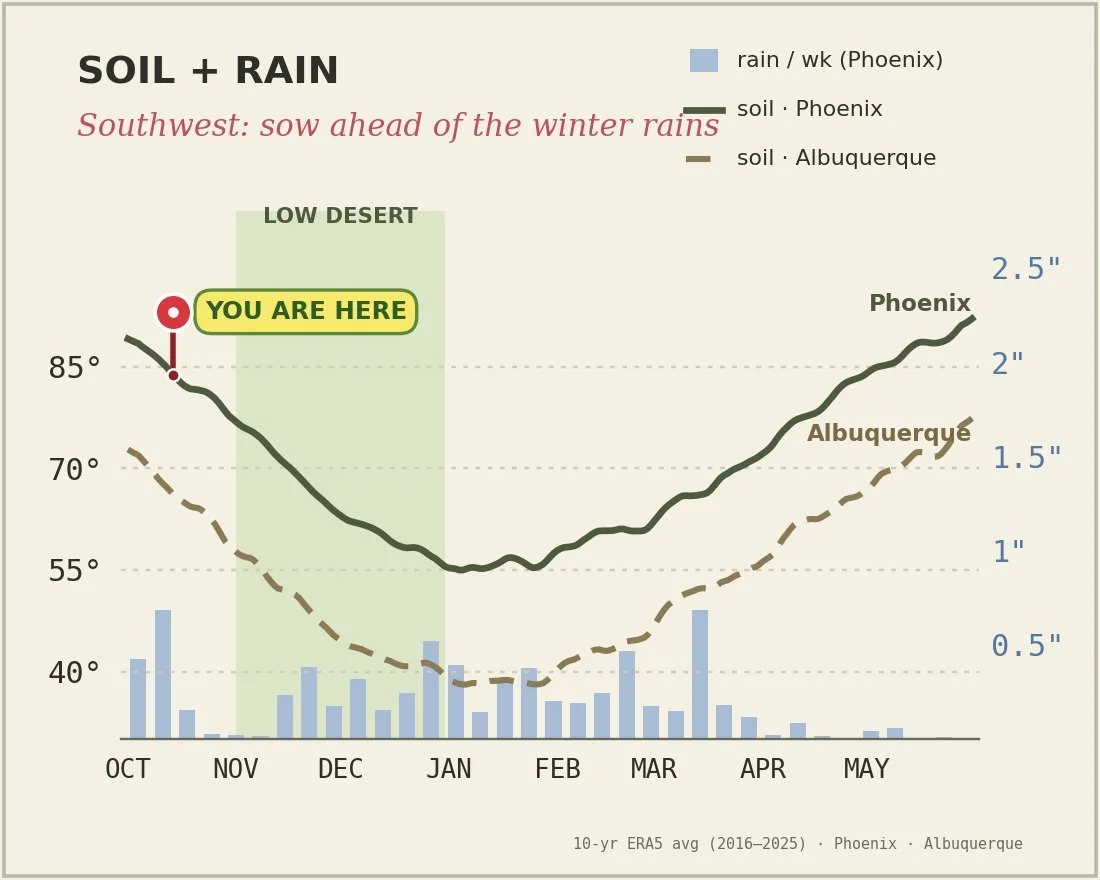
The Southwest rarely gets the 1¼ inches of rain in three weeks that the other regions count on, so timing to the rain matters more than anywhere else. In the low desert, Phoenix soil drops from the mid-80s in October to about 70°F in November and 60°F in December, and winter storms bring about an inch a month with no hard freezes. Seed sown in November with a few deep waterings to get it started can ride the winter rains to a spring bloom. The high desert (Albuquerque) is drier still, under an inch a month, with 12–19 hard-freeze nights in midwinter. Seed choice matters more there than anywhere else in this forecast. Some high-desert natives are summer germinators that wait for monsoon rain; others need a cold winter before they’ll sprout. Sources don’t agree on one calendar either: the Xerces Society lists February through May for Southwest wildflowers, while Arizona water-conservation programs point to fall sowing ahead of winter rain. We’ve kept two windows and noted which kind of seed each one suits.
Month by month · Phoenix and Albuquerque
| Month | Phoenix soil | Phoenix rain | Phoenix ≤28°F | Albuquerque soil | Albuquerque rain | Albuquerque ≤28°F |
|---|---|---|---|---|---|---|
| Oct | 84°F | 1.3" | — | 66°F | 1.1" | 0.6 |
| Nov | 70°F | 0.8" | — | 52°F | 0.9" | 4.5 |
| Dec | 60°F | 1.3" | — | 42°F | 0.8" | 12 |
| Jan | 56°F | 1.2" | — | 38°F | 0.7" | 18.6 |
| Feb | 60°F | 1.2" | — | 43°F | 0.7" | 9.8 |
| Mar | 67°F | 1.2" | — | 52°F | 0.8" | 2.1 |
| Apr | 78°F | 0.1" | — | 62°F | 0.7" | 0.2 |
| May | 88°F | 0.1" | — | 72°F | 0.6" | — |
Our advice
- Low desert (Phoenix, Tucson): sow in November and December, and water deeply two or three times to get seed started.
- High desert (New Mexico, southern Colorado and Utah): sow cool-season species in late fall onto cold ground; save summer-germinating species for late June, just ahead of the monsoon.
- Oklahoma and western Texas: dormant sowing in late November, or spring with April rains.
West
Mountains and high plains: snow-sown seed, spring bloom
- Best sowing
- Dormant sowing mid-November to mid-January · spring sowing mid-April through May
- Covers
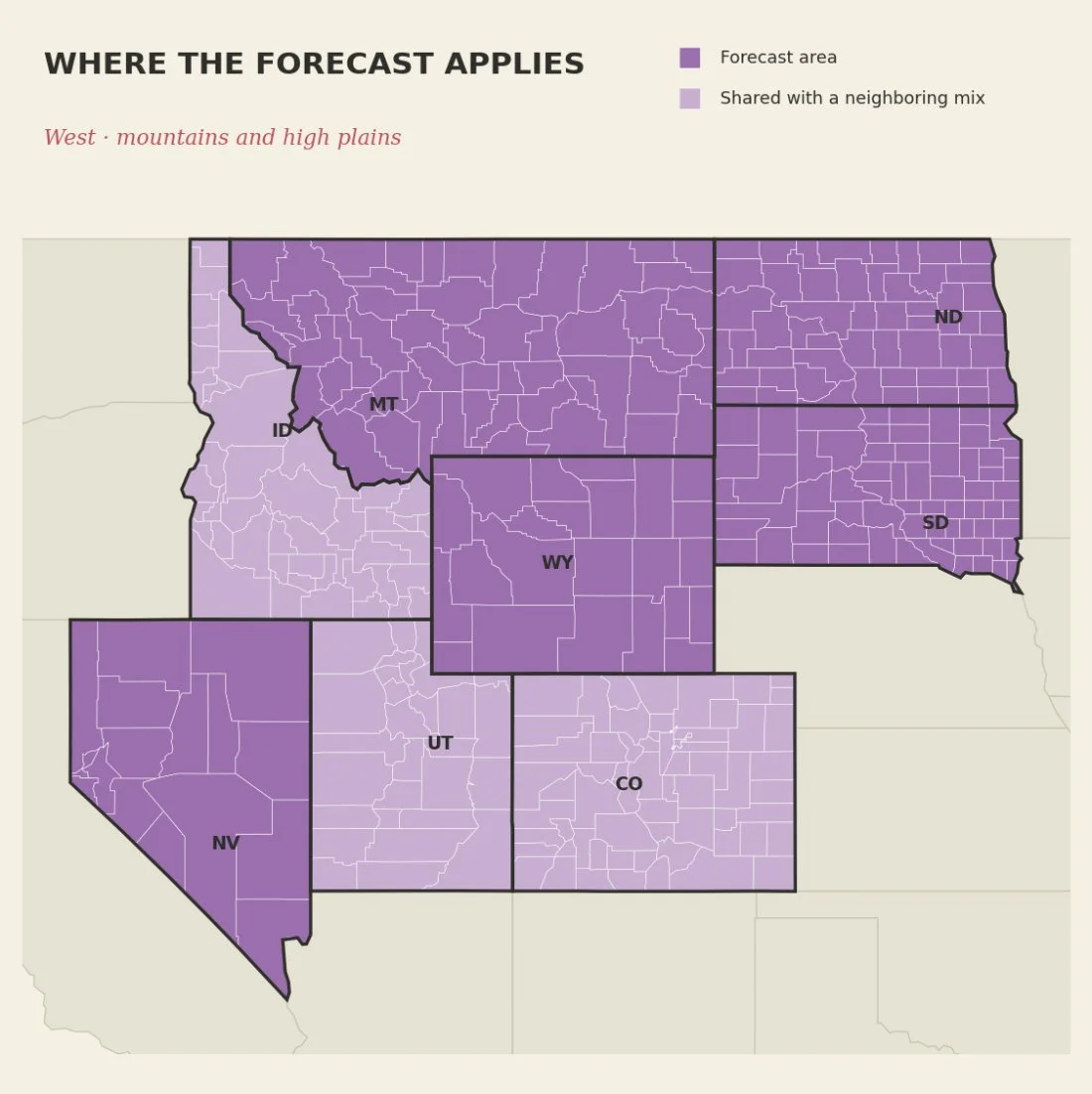
- Colorado, Idaho, Montana, North Dakota, South Dakota, Utah, Wyoming, northern Nevada, eastern Washington and Oregon
- Sample cities
- Denver, Boise, Reno
Shop the West Mix → Nevada Mix →
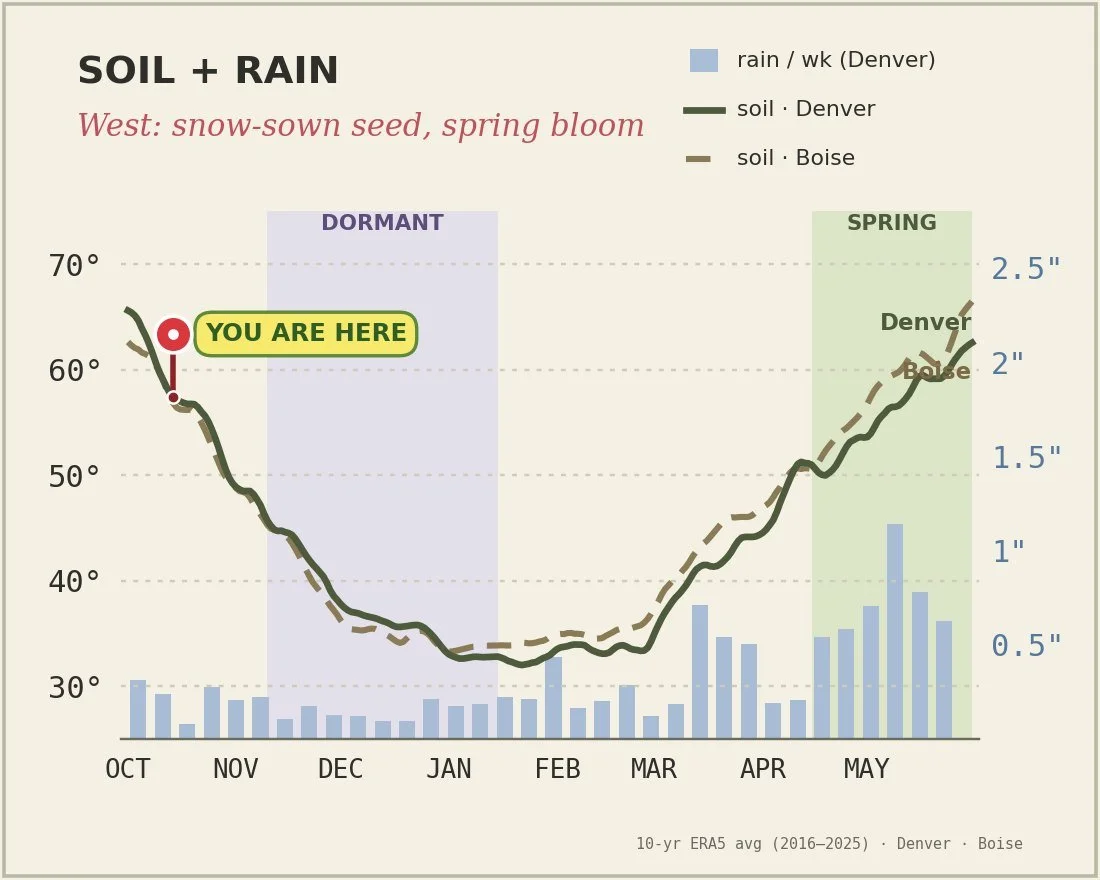
The West is the coldest, driest region in the forecast. Denver soil falls into the mid-40s by November with about 16 hard-freeze nights, then 25–30 a month through February, and winter precipitation stays under an inch a month. Dormant sowing fits this climate well: seed on cold ground waits under snow, and spring melt waters it in. Reno and Boise get more winter moisture (2–3 inches a month December–February). Spring sowing opens mid-April as soil passes 50°F, with May bringing the wettest month of the year on the Front Range.
Month by month · Denver and Boise
| Month | Denver soil | Denver rain | Denver ≤28°F | Boise soil | Boise rain | Boise ≤28°F |
|---|---|---|---|---|---|---|
| Oct | 58°F | 1.0" | 3.9 | 57°F | 1.1" | 1.4 |
| Nov | 44°F | 0.7" | 15.8 | 43°F | 1.4" | 9.1 |
| Dec | 36°F | 0.6" | 25.9 | 35°F | 2.3" | 19.6 |
| Jan | 33°F | 0.9" | 29.7 | 34°F | 2.0" | 19.2 |
| Feb | 34°F | 1.0" | 25.1 | 35°F | 2.0" | 16.5 |
| Mar | 41°F | 2.0" | 20.2 | 43°F | 1.8" | 7 |
| Apr | 50°F | 1.7" | 7.2 | 52°F | 1.3" | 1 |
| May | 58°F | 3.5" | 0.5 | 61°F | 1.6" | — |
How we’d sow it
- Sow from mid-November onto cold, bare ground, ideally just before a snow.
- Press seed in; wind is the bigger risk than washout here.
- Spring: sow from mid-April into May, timing to the spring storms.
- Where this varies: timing shifts with elevation, and mountain towns can run weeks behind Denver.
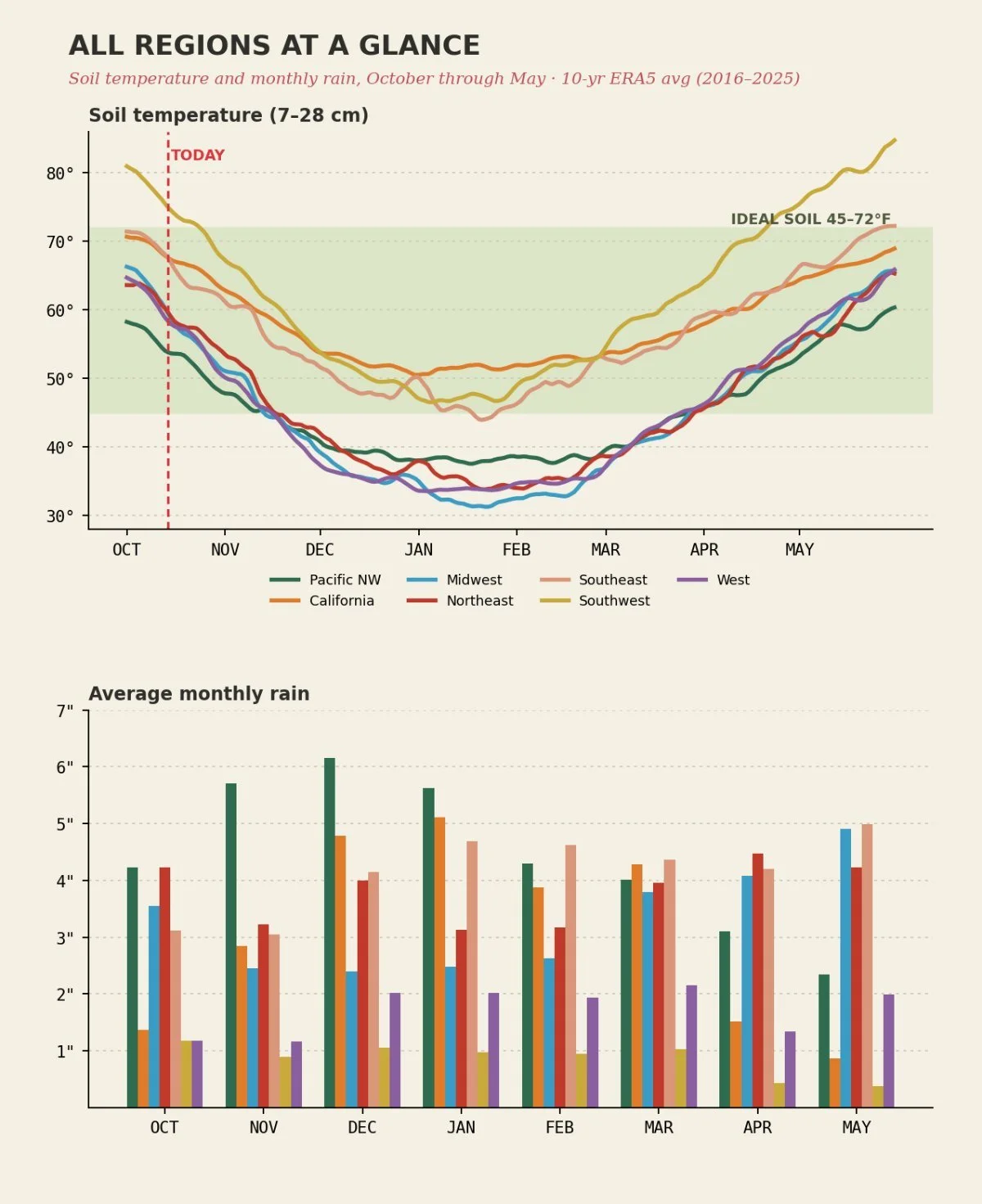
All regions at a glance
Soil temperature and monthly rain, side by side
Behind the numbers
Where the data comes from and how we used it
Weather data
- Source: ERA5 and ERA5-Land reanalysis from the European Centre for Medium-Range Weather Forecasts, pulled through the Open-Meteo historical weather service. Reanalysis blends weather observations into a consistent grid; each value represents an area roughly 9 to 25 km across, not a single backyard or weather station.
- Period: daily values for 2016 through 2025, averaged by calendar day. Soil curves are smoothed over 7 days.
- Sample cities: Portland, Seattle and Spokane (Pacific Northwest); San Francisco, Sacramento, Modesto, Salinas, Arcata, Los Angeles and San Diego (California); Des Moines and Columbus (Midwest); Albany and Philadelphia (Northeast); Atlanta, Raleigh, Orlando and Austin (Southeast); Phoenix and Albuquerque (Southwest); Denver, Boise and Reno (West).
- Soil temperature is the 7–28 cm (about 3–11 inch) layer. Rain is daily precipitation summed by week or month. Freeze nights count days when the overnight air temperature fell to 28°F or below.
El Niño comparison
- Rain: the same reanalysis at the San Francisco grid point, October 1 through April 30, for every winter from 1950–51 to 2025–26. Reanalysis tends to read a little drier than San Francisco’s rain gauges, so we focus on the differences between winter types rather than the exact totals.
- Classifying winters: NOAA’s Oceanic Niño Index for the December–February season of each winter. El Niño is +0.5 or higher; strong is +1.5 or higher; La Niña is −0.5 or lower; everything else is neutral. That gives seven strong El Niño winters: 1957–58, 1972–73, 1982–83, 1991–92, 1997–98, 2015–16 and 2023–24.
- First inch of rain: the date each season’s rain total first reaches one inch, counting from October 1.
- Storm days: days with at least one inch of rain. Rainy days: days with at least a tenth of an inch.
Sowing windows
The windows are our judgment, not a model output. We start from where the three working rules line up in the data for each region, check them against the published guidance listed below, and adjust from what we’ve seen grow. We don’t yet model each species in each mix; when we do, we’ll say so here.
Sources
- NOAA Climate Prediction Center, ENSO diagnostic discussion (October 8, 2026)
- NOAA Oceanic Niño Index
- Open-Meteo historical weather API (ERA5 and ERA5-Land)
- UC Davis Arboretum and Public Garden, California native wildflower seeds
- Xerces Society, Establishing Pollinator Meadows from Seed
- Prairie Moon Nursery, Cultural Guide (germination codes and fall sowing)
- Farmers for Monarchs, Dormant seeding
- Lady Bird Johnson Wildflower Center, when to plant wildflower seeds
- Water – Use It Wisely, fall planting wildflowers (Arizona)
Want the raw numbers for your area? Email us at hi@sfinbloom.art.
Not sure which mix is yours? See all mixes by region.